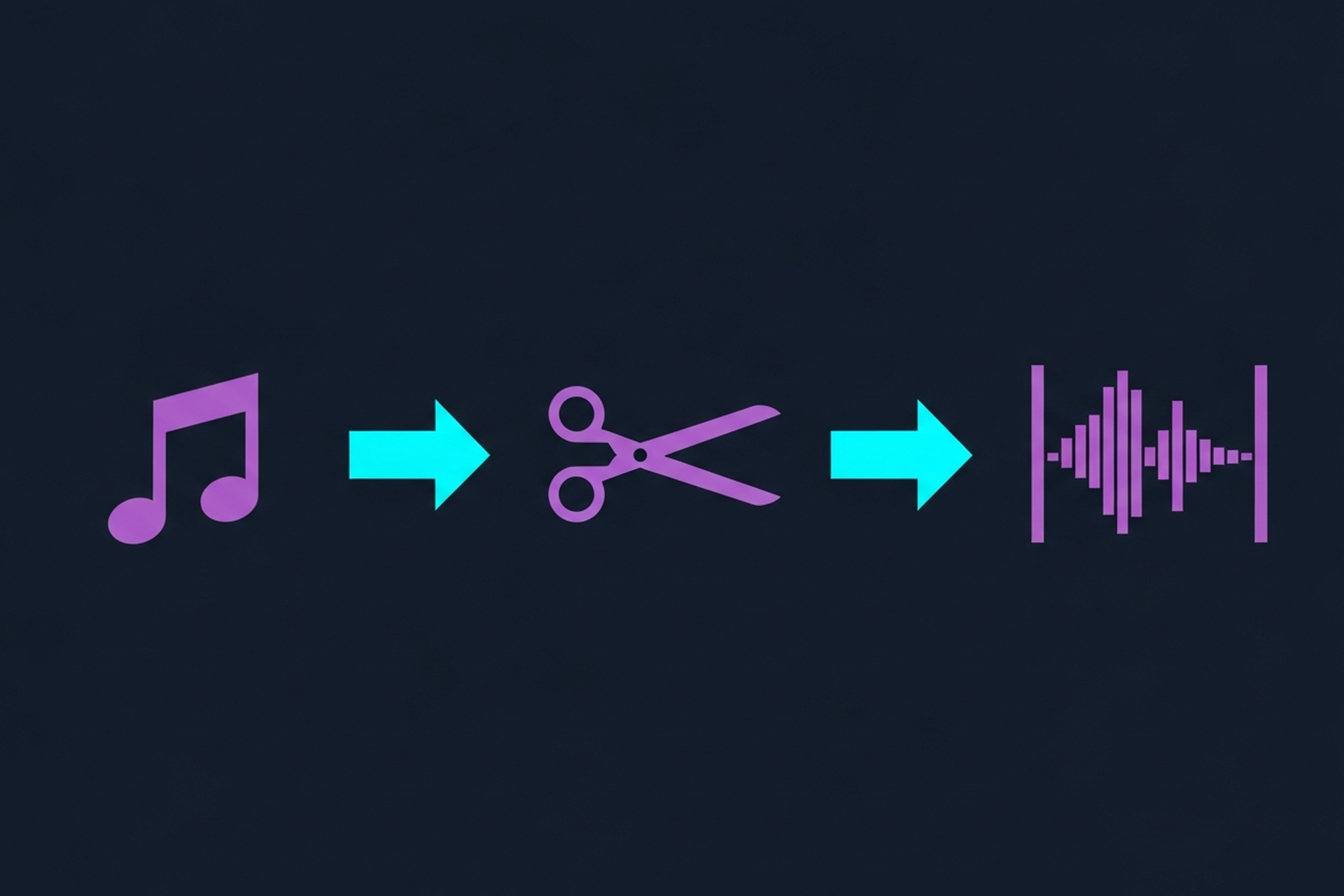

A ten-minute track does not fit a six-second podcast intro. You need to cut it. That sounds simple, but the wrong tool makes it slow, the wrong process makes it sound amateur, and the wrong settings can degrade audio quality before your episode ever goes live.
This guide is for B2B content teams and podcast producers who need to cut music files cleanly and efficiently. We review the best apps for the job in 2026, covering free and paid options, and we tell you which one fits which workflow.
Not every audio editor is equally good at cutting music. Before we get into specific tools, here is the checklist that matters for podcast production:
Precise selection controls. You need to be able to set cut points at exact timestamps. Eyeballing it is not good enough when you need a 7-second intro.
Fade-in and fade-out controls. A cut without a fade sounds jarring. The app needs to handle this cleanly with adjustable fade lengths.
Non-destructive editing. The best apps let you work on a copy of your file without overwriting the original. If you need to go back and cut a different section, the original should still be intact.
Clean export options. You need control over format (MP3, WAV), bitrate, and sample rate. Apps that only export in one format at one quality level create unnecessary friction.
Stability and speed. No app is useful if it crashes on large files or takes forever to render exports.
Audacity remains the most widely used free audio editor for podcast production, and it handles music cutting well. The waveform view gives you a clear visual of the track. The selection tool lets you highlight exactly the region you want to keep. Fade-in and fade-out effects are a few clicks away.
Best for: Teams doing occasional music cuts who do not want to pay for software. Works on Mac, Windows, and Linux.
Limitations: Audacity uses a destructive editing model, meaning changes are made to the working file. Always work from a copy, not your original. The interface is also dated and less intuitive than paid options.
Export quality: Excellent. Full control over MP3 bitrate and sample rate.
GarageBand is the Mac alternative that offers a more modern interface and non-destructive workflow. Drop your music file into a new audio track, use the scissors tool to make cuts at specific points, and add fades using the volume automation lane.
GarageBand also supports tempo-synced editing, which can help when you want cuts to land on musical beats rather than arbitrary timestamps.
Best for: Mac users who want non-destructive editing at no cost. Also useful for teams that produce video content and want to stay in the Apple ecosystem.
Limitations: Mac only. Designed for music production, so the interface has features you will not use for podcast work. No Windows version.
Audition is the professional choice for high-volume podcast production environments. The Waveform Editor gives you precise control over cuts. The Multitrack view lets you see how your music clip sits alongside voice tracks. You can apply fades by dragging handles at the edge of each clip.
Audition also has a Match Loudness feature that lets you normalize your music clip to a specific loudness level, which saves time when level-matching against voice tracks.
Best for: Production teams handling 8 or more episodes per month. Worth the subscription cost for teams doing consistent podcast work.
Limitations: Requires an Adobe Creative Cloud subscription. Higher learning curve than free options. Overkill for teams that only cut music occasionally.
For a broader comparison of professional editing tools and where Audition fits in a full B2B production stack, see our guide on best voice editing software.
Logic Pro is a professional-grade option for Mac users who prefer a one-time purchase over a subscription. Its Flex Time and Flex Pitch features go beyond basic cutting, but for straightforward music trimming tasks, the workflow is similar to GarageBand but with better precision tools.
Logic Pro handles large audio files well and exports cleanly in all major formats.
Best for: Mac-based teams doing both podcast and video production who want professional tools without a monthly subscription.
Limitations: Mac only. Higher upfront cost than a short-term Audition subscription. Not necessary if you only need basic cutting capabilities.
Descript is primarily a transcript-based podcast editor, but it handles music clips inside full episode projects. If your team uses Descript for voice editing, you can import your music, trim it to length, and place it within your episode without switching tools.
Best for: Teams already using Descript for podcast editing who want to keep music work in the same environment.
Limitations: Music editing is not Descript's primary focus. For standalone music cutting tasks, other tools give you more precise control. The subscription cost is also higher than Audition for comparable functionality.
WavePad is a dedicated audio editor from NCH Software that offers a free version with core cutting capabilities and a paid version that adds features like batch processing and spectral analysis. The interface is simpler than Audition and more focused on practical audio editing tasks.
Best for: Windows users who want a lighter-weight free option compared to Audacity, with a slightly more modern interface.
Limitations: The free version has a watermark on exported files in some formats. The paid upgrade removes this. Not as widely used in podcast production communities, so less community support and documentation.
| App | Cost | Platform | Non-Destructive | Best For |
|---|---|---|---|---|
| Audacity | Free | All | No | Occasional cuts, budget teams |
| GarageBand | Free | Mac only | Yes | Mac users, light volume |
| Adobe Audition | Subscription | All | Yes | High-volume production |
| Logic Pro | One-time | Mac only | Yes | Mac professionals |
| Descript | Subscription | All | Yes | Teams using Descript already |
| WavePad | Free/Paid | All | Yes | Windows users, simple needs |
The tool matters, but the process matters more. Here is the workflow that produces clean cuts every time:
Step 1: Work from a copy. Never edit the original music file. Duplicate it and edit the copy. This preserves your options.
Step 2: Identify cut points by ear. Play the track and find the beat or phrase where you want your clip to start and end. Cuts at musical phrase boundaries sound intentional. Cuts in the middle of a phrase sound like errors.
Step 3: Make the cut precisely. Set your in and out points at the timestamps you identified. Use your editor's zoom function to see the waveform in detail, especially near the cut points.
Step 4: Apply fades. Fade-in: 0.2 to 0.5 seconds. Fade-out: 1 to 3 seconds depending on the mood you want. Do not skip this step.
Step 5: Check the level. If you are going to use this clip alongside voice audio, preview it at the volume level it will actually play at in the episode. Music for podcast intros typically sits around -15 dB to -20 dB relative to the voice track.
Step 6: Export clean. MP3 at 192 kbps, 44.1 kHz. Name the file clearly and archive the original.
Cutting music is one task inside a broader post-production process. For B2B brands running branded podcast programs, the goal is a production workflow that delivers consistent quality across every episode without requiring your team to make judgment calls from scratch each time.
That means documented standards for music placement, standardized clip lengths for each show format, and a clip library that gets updated rather than rebuilt each season.
Understanding what complete podcast production services cover helps you see where your in-house workflow needs structure. For teams that want to focus on content strategy and guest relationships rather than audio production, professional podcast production handles every technical layer including music preparation and placement.
There is a practical threshold here. If your team is spending more than 30 to 45 minutes per episode on audio production tasks including music cutting, normalization, and level matching, the time cost exceeds the production cost of outsourcing.
B2B podcast production services handle all of this as standard deliverables. Every episode ships with properly prepared music, professional voice editing, and quality-checked audio. Your team focuses on what they do best.
If you are evaluating what outsourced podcast production looks like for your show, contact Podsicle Media. We produce B2B podcasts end-to-end for marketing teams who want professional output without the production overhead.
The best app to cut music depends on your platform, budget, and volume:
The process is consistent regardless of tool: work from a copy, cut at phrase boundaries, apply fades every time, and export at 192 kbps. Build a clip library so your team is not re-cutting the same track repeatedly.
Clean music production is not the hardest part of running a B2B podcast. But it is the kind of detail that separates shows that sound professional from shows that sound like they were thrown together.