
Audio quality is one of the first things a listener uses to judge a podcast. Bad audio, echo, background noise, and uneven levels signal that the show isn't serious. Good audio signals that it is. For a B2B show trying to build credibility with buyers, that judgment happens fast.
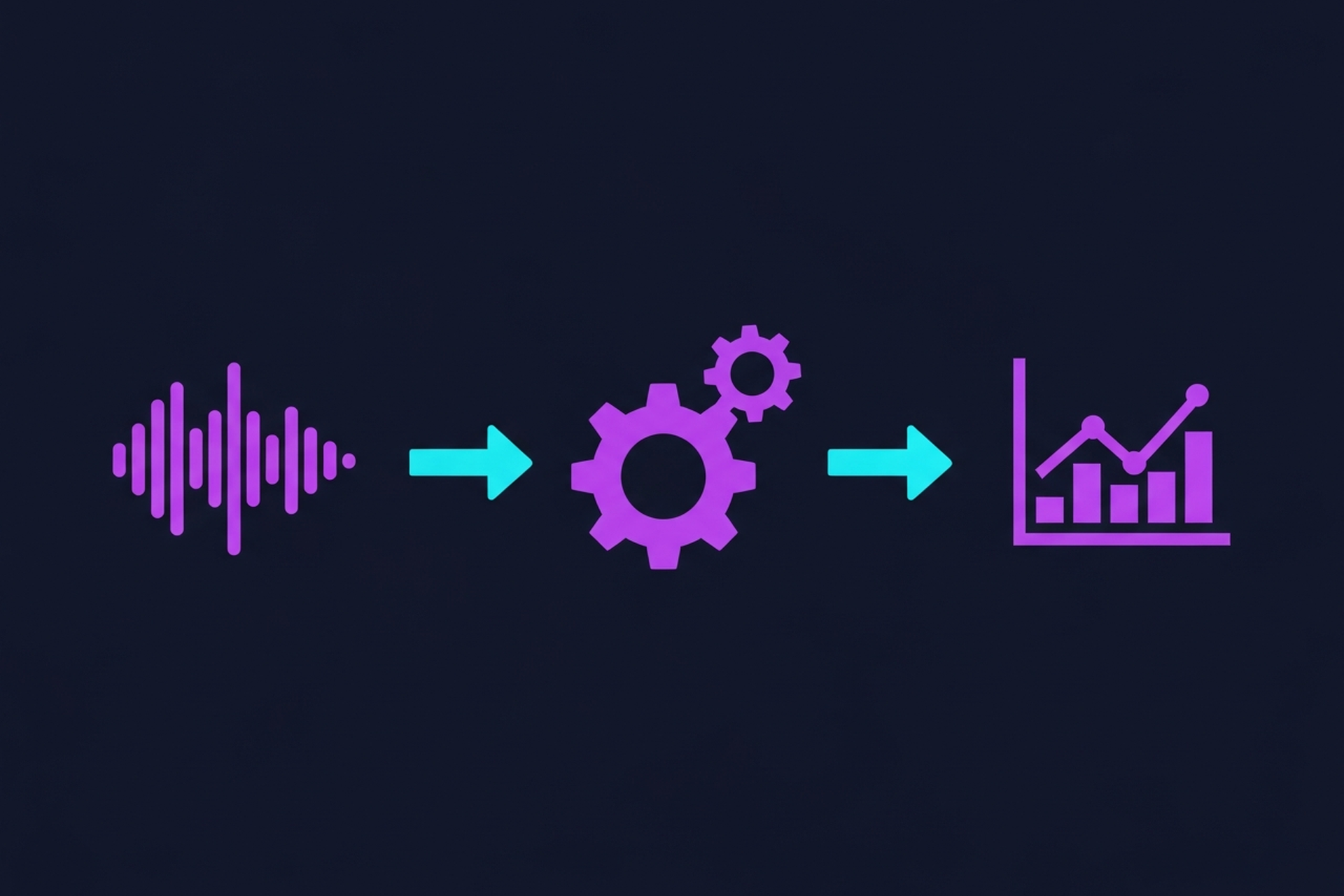
Audio enhancer apps have gotten significantly better over the last few years, particularly with AI-driven noise reduction and voice isolation. Some of them genuinely rescue recordings that would otherwise be unusable. But they're not magic, and understanding what they actually do helps you use them correctly, and set the right expectations.
Audio enhancement covers a cluster of related processes:
Noise reduction removes background sounds, air conditioning, keyboard clicks, traffic, fan hum, from a recording. Traditional noise reduction required you to identify a sample of "noise only" audio and apply a filter. Modern AI-based noise reduction does this automatically, often in real time.
Voice isolation separates the speaker's voice from other audio content. This is especially useful for recordings made on a laptop microphone in a room with ambient noise, or for calls where a remote guest has poor audio.
Normalization and leveling adjust the overall volume of a recording to a consistent target level. This is distinct from noise reduction: it doesn't remove bad sounds, it ensures the volume is appropriate for playback. Proper normalization typically targets -16 LUFS for stereo or -19 LUFS for mono, which are the standard levels for most podcast platforms.
EQ and voice clarity adjusts the frequency profile of a recording to make voices sound cleaner and more present. Reducing low-end rumble, adding a slight presence boost, and controlling harshness are the most common adjustments.
Most audio enhancer apps combine several of these processes into a single workflow or preset system.
Adobe's web-based audio enhancer is one of the most accessible AI enhancement tools available. Upload an audio file, and it applies noise reduction and voice isolation automatically. The results are genuinely impressive on recordings made in non-ideal conditions, a laptop mic in a reverberant room, a phone recording with traffic noise, a remote call with intermittent echo.
It's free (with an Adobe account), requires no installation, and is fast enough to process a 45-minute episode in a few minutes. For B2B teams without a dedicated audio engineer, it's often the first tool to try on a problem recording.
For a full comparison of how Adobe Podcast fits into a broader editing toolkit, see [./podcast-editing-tools.md].
If your team is already using Descript for episode editing, Studio Sound is built directly into the editing interface. Enable it with a toggle and it applies noise reduction, voice leveling, and clarity processing to the entire track. It's not as aggressive as Adobe Enhance but it's seamlessly integrated into the editorial workflow, which matters for teams prioritizing speed.
Auphonic is an audio post-production service specifically designed for podcasts. It handles leveling, noise reduction, loudness normalization, and file format conversion, all automated. It integrates directly with most podcast hosting platforms, so you can upload a raw recording, process it, and push the finished file to your host in a single workflow.
Auphonic's normalization algorithms are particularly good. For teams that need consistent loudness across all episodes, especially shows with multiple hosts or frequently varying guest audio quality, Auphonic is worth the subscription.
For teams recording video podcasts with supported NVIDIA graphics cards, RTX Voice applies real-time AI noise suppression during recording. This is particularly useful if your recording environment isn't acoustically treated, it removes background noise before it ever enters the recording, rather than trying to remove it in post.
The limitation is hardware dependency. It requires an NVIDIA RTX GPU, which most podcast setups don't have. But for companies with video podcast studios running on qualifying hardware, it's one of the most effective noise reduction tools available.
RX is a professional-grade audio repair tool, not an entry-level enhancer. It handles problems that AI-based tools struggle with: intermittent noise, clipping, room reverb, mouth clicks, and audio that was fundamentally compromised at the recording stage.
RX is expensive (several hundred dollars) and has a learning curve. It's the right choice when a recording has a problem that simpler tools can't fix, a guest recorded in a bathroom, severe clipping, or persistent echo that AI reduction makes worse rather than better.
This is the part that matters most.
Clipping. If audio peaks above 0 dBFS during recording, causing digital distortion, no enhancement tool can fully recover the original sound. Clipped audio has a harsh, crunchy quality that enhancement makes more noticeable, not less. Set your recording levels conservatively: aim for peaks around -12 dBFS and never above -6 dBFS.
Excessive reverb. AI noise reduction handles steady-state background noise well. Room reverb, the echo you get from recording in a hard-surfaced room, is much harder to remove. Light reverb can be reduced; heavy reverb in an untreated room typically can't be fully fixed in post. The solution is acoustic treatment or recording in a naturally dampened environment (a closet, a vehicle, a room with carpet and soft furnishings).
Fundamentally bad source audio. Audio from a phone speaker, a laptop webcam microphone, or a low-quality Bluetooth device often doesn't have enough usable signal for enhancement to work on. Enhancement amplifies what's there. If what's there is poor quality signal with a high noise floor, you get cleaner noise, not cleaner voice.
Multiple overlapping problems. Enhancement tools work better on isolated problems. A recording with noise reduction artifacts from one tool, reverb, and poor levels simultaneously is genuinely difficult to fix. Fix one problem at a time, in order: remove noise first, then adjust levels, then apply EQ.
For most B2B shows, this is a workable post-production audio workflow:
For a complete breakdown of podcast post-production workflows, including how to handle common guest audio problems, see [./podcast-editing-tools.md] for a guide to the tools that support each step.
AI enhancement tools have closed the gap significantly between self-edited and professionally edited audio. For most B2B shows, a combination of good recording practices and AI post-processing produces results that are entirely listenable and credible.
The gap that remains is in complex problem-solving. An experienced audio engineer using tools like iZotope RX can recover recordings that AI tools can't. They can also make creative decisions that automated tools can't make: where to cut for pacing, how to handle a guest who spoke too quietly, whether a technical glitch should be edited out or left in.
For high-stakes content (a flagship episode, a client testimonial, an event recording), professional post-production is worth the cost. For regular weekly episodes with good source audio, AI enhancement plus tight editing is usually sufficient.
If you're working with a done-for-you production service, audio cleanup should be included in what they deliver. Ask specifically how they handle guest audio that comes in at poor quality, the answer tells you a lot about the production quality you should expect.
Audio enhancer apps are genuinely useful tools, not marketing noise. The good ones, Adobe Podcast Enhance, Descript Studio Sound, Auphonic, solve real problems and produce measurably better audio. The key is understanding what they fix and what they can't.
Start with your recording environment and gain staging. Enhancement is most effective when it's cleaning up minor issues in otherwise solid source audio. If you need enhancement to save a fundamentally bad recording, you'll get marginal results.
Ready to take audio quality off your plate entirely? Get Your Free Podcasting Plan to see how Podsicle Media handles audio post-production end to end.