The cost of a radio ad is trickier to nail down than it should be. There is no public rate card. Stations negotiate, bundle, and discount constantly. What a competitor paid last quarter probably does not match what you will pay today.
This post cuts to the mechanics. We are not talking about radio advertising in general terms. We are breaking down the per-unit economics: how much a single spot costs, what variables move that price, and how to calculate whether the investment actually pencils out.
Almost every radio buy comes down to two formats: 30-second spots and 60-second spots. Occasionally you will see 15-second sponsorship tags, but they are the exception, not the rule.
Here is the key: the pricing relationship between these two is not linear.
A 60-second spot does not cost twice what a 30-second spot costs. In practice, a 60-second spot runs at roughly 1.5x to 1.8x the price of a 30-second spot on the same station, at the same daypart. Stations charge a premium for the extra time, but they also want to move inventory, so they rarely push it to a true 2x multiple.
Why does this matter? Because message density.
If your product or service needs more than 30 seconds to explain, you will pay that 1.5x to 1.8x premium for the 60-second version. If your message can fit in 30 seconds, that is almost always the more efficient buy on a cost-per-exposure basis.

The biggest price driver in radio advertising is not spot length. It is reach tier. There are three distinct buying levels, and each has its own pricing logic.
Local stations sell time directly to local advertisers. This is the most accessible entry point for small and mid-size businesses. You are buying reach in a single geographic market.
Typical local 30-second spot costs:
| Market Size | Off-Peak | Midday | Morning Drive |
|---|---|---|---|
| Small market (under 500K population) | $50 - $150 | $100 - $300 | $200 - $500 |
| Mid-size market (500K - 2M) | $150 - $400 | $300 - $700 | $500 - $1,200 |
| Top-10 metro market | $400 - $900 | $700 - $1,500 | $1,000 - $3,000+ |
These are per-airing costs. A typical campaign frequency means you are running 15 to 30 spots per week, so multiply accordingly.
For a deeper look at how local buys work, see our guide to local radio advertising.
Network radio means buying time across a syndicated network of stations simultaneously. Instead of negotiating with one station in Denver, you buy a package that runs on 50 or 500 stations at once.
Major network operators include Westwood One, CBS Radio Network, and iHeartMedia's national network. The pricing flips: instead of paying per-station, you pay a network CPM (cost per thousand listeners).
Network radio CPMs typically range from $6 to $15 per thousand listeners, depending on the daypart, format, and audience demographics. At that CPM, a campaign reaching 5 million listeners per week costs roughly $30,000 to $75,000 per week, before production.
This is not a starter tier. It is for brands that have already validated their radio creative and want to scale reach quickly.
National spot buying sits between local and network. You contract directly with individual stations in multiple cities, one market at a time. It requires more logistics than network buying, but gives you more geographic control.
Expect to pay a 20% to 40% premium over local rates when buying the same dayparts through a national spot rep. The premium reflects the added coordination and the station's leverage when negotiating with non-local buyers.
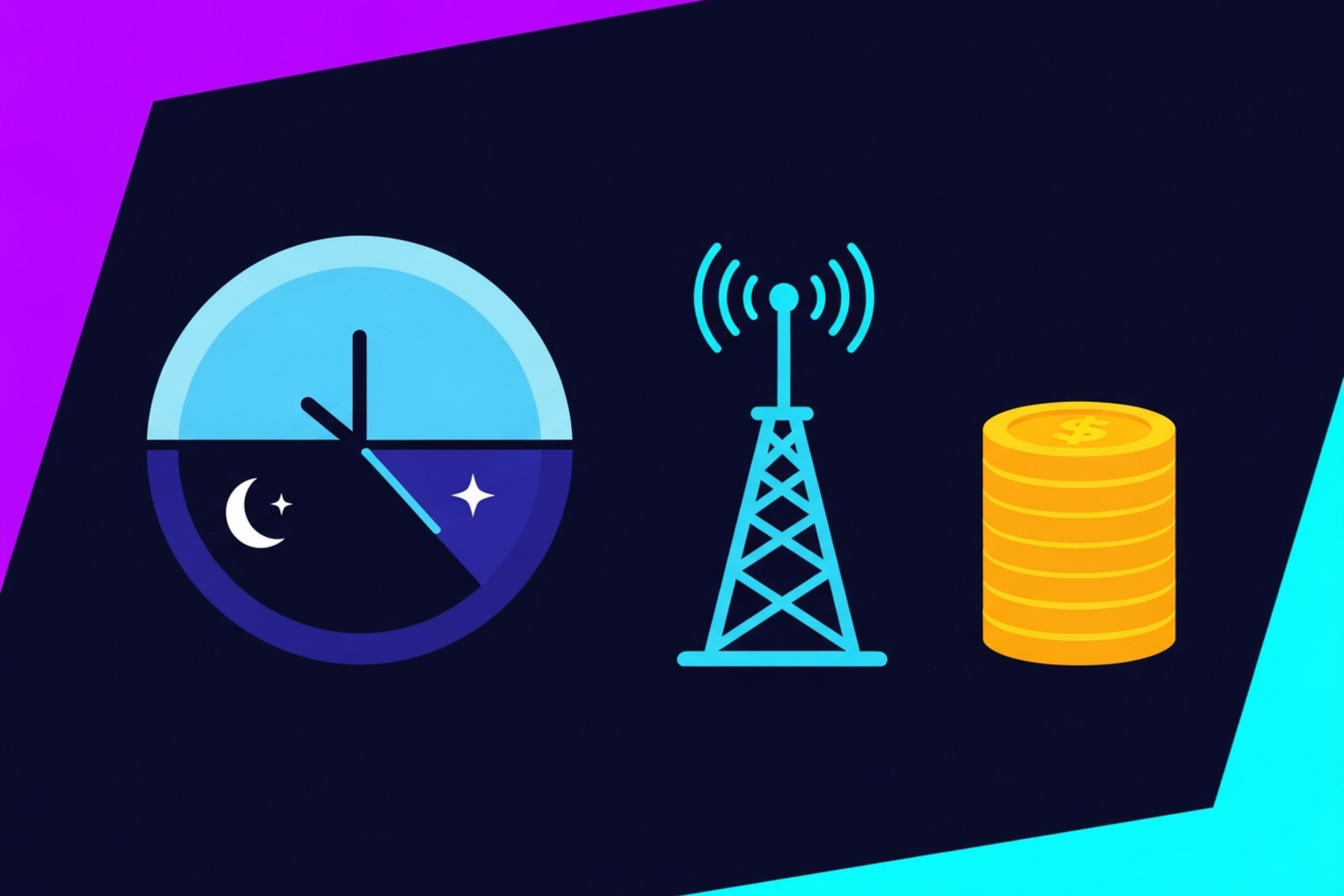
Daypart is the most predictable pricing lever in radio. It follows audience concentration, so the pattern is consistent across virtually every market.
For most B2B advertisers, midday offers the strongest cost-efficiency ratio. Morning drive is premium priced partly because of inertia from decades of buyer behavior, not necessarily because your specific audience is better concentrated there.
Every cost breakdown of radio advertising should include production. Many do not, which is how buyers end up with sticker shock.
Radio ad production costs break into three categories:
1. Station-produced spots Most local stations will produce a basic spot for free or near-free, typically $0 to $250. The catch: quality varies widely, and the station owns the creative, which means you cannot run it elsewhere. Fine for a short-term local test. Not ideal for a sustained brand campaign.
2. Independent radio production Working with an independent production house gives you better talent and full ownership of the finished asset. Budget $500 to $2,500 for a well-produced 30 or 60-second radio spot. This includes voiceover, music licensing, mixing, and mastering.
3. Agency-produced spots If you are working with a radio advertising agency that handles your buy, production is often bundled into their fee structure. Expect $1,500 to $5,000+ per spot when an agency is managing the full creative-to-air workflow. Large campaigns with multiple creative versions will push toward the higher end.
Music licensing is a separate line item. Stock music runs $50 to $500 per track depending on the license. Original composition for a brand campaign is $1,000 to $10,000+. Buying a known song? Expect a conversation with a music supervisor and a budget in the five figures minimum.
When you call a station or rep to advertise radio time, you will not get a price list. You will get a conversation. Here is how to come prepared.
What stations will ask you:
What you should ask them:
Stations have significant flexibility on pricing, especially for longer commitments. A 13-week commitment will almost always get you a better per-spot rate than a 4-week flight. Do not accept the first number.
To make this concrete, here are three realistic campaign scenarios.
Local B2B brand, mid-size market
Regional brand, multiple markets
Network radio test
Here is the honest comparison.
Traditional radio CPMs for well-defined audience targeting typically run $10 to $25 per thousand listeners, once you factor in production and agency fees. Top-rated drive time programming on major market stations can push CPMs toward $30 to $40 when all-in costs are calculated.
Podcast advertising CPMs typically range from $15 to $50 per thousand downloads, depending on format, show type, and placement. Host-read ads run at the higher end. Pre-produced spots at the lower end.
On a raw CPM basis, the ranges overlap. But podcast advertising comes with several practical advantages:
If you are asking whether radio or podcasting makes more sense for your budget, the comparison is not really about CPM. It is about what you can measure and what you can optimize. Radio can build awareness at scale. Podcasting can build awareness at scale and give you the data to prove it.
For a full CPM breakdown by show tier and format, see our guide on podcast advertising rates.
If you are evaluating radio as part of a broader media mix, the per-unit cost mechanics above are your starting point. Build your scenario using the ranges in this post, add production, factor in frequency, and stress-test the CPM math against your conversion funnel.
If radio's reach-to-cost tradeoff does not pencil out, or if measurement is a hard requirement, podcast advertising is worth a serious look. Podsicle Media helps B2B brands evaluate both channels and build campaigns that perform.
Ready to run the numbers? Talk to our team and we will walk through the real costs for your market and audience.