
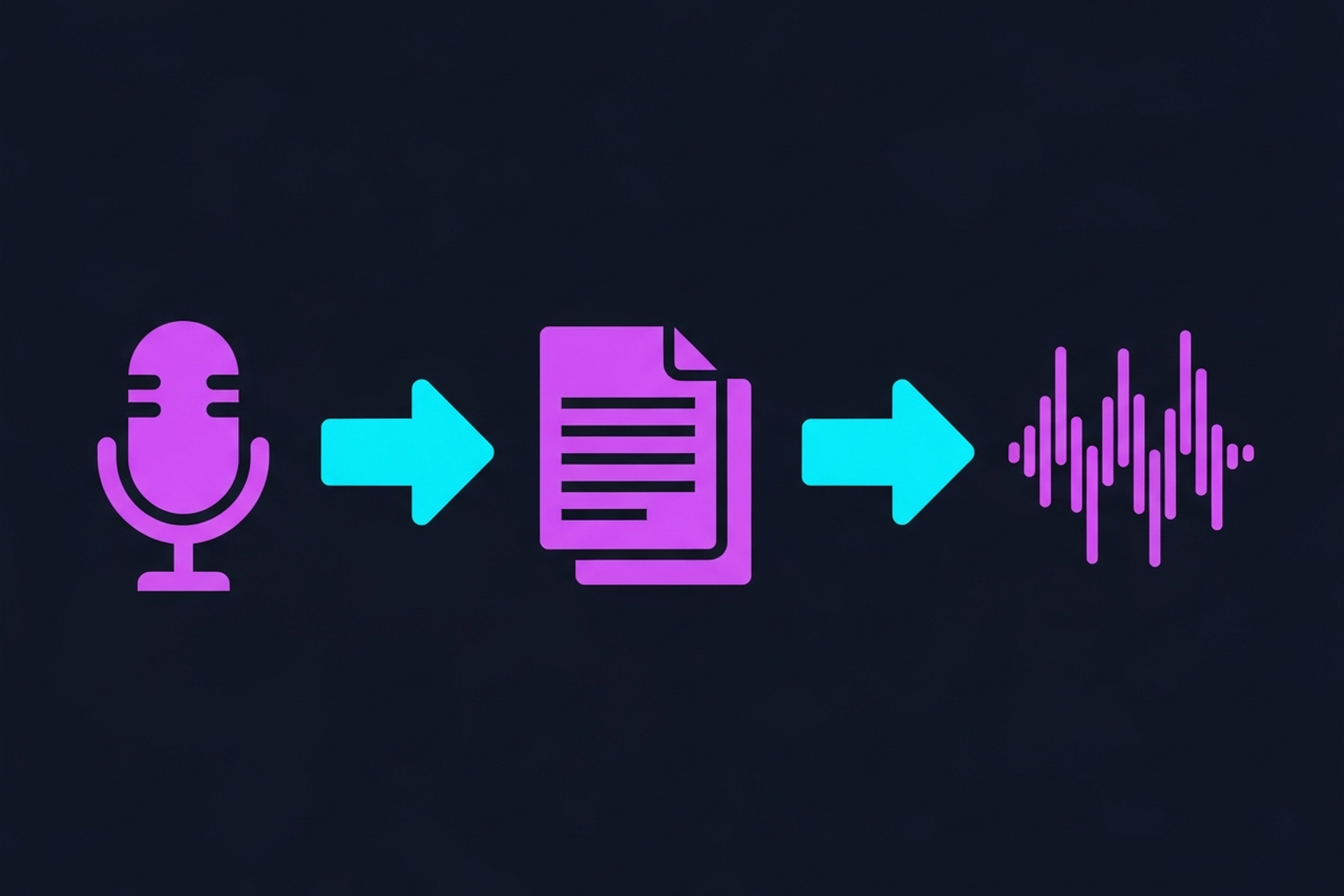

Most B2B companies that launch a podcast do the same thing: record the episode, publish it, post a link on LinkedIn, and move on. They have created an hour of original content and distributed 5% of it.
That is the problem podcast repurposing solves. One episode, done well, can produce a week's worth of content across multiple channels. This guide walks through exactly how to do it, in the order that makes production most efficient.
Everything else in your repurposing workflow depends on having a clean transcript. This is step zero, not optional.
A transcript turns a 45-minute audio conversation into a searchable, editable text document. From that document you can pull quotes, identify segments, extract key points, and generate every other derivative asset without listening to the episode multiple times.
Use a transcription tool that handles multi-speaker audio accurately. Descript, Otter.ai, and Riverside's built-in transcription all work reasonably well for studio-quality podcast audio. For accuracy above 95% on technical B2B content, you will likely need light human editing regardless of which tool you use.
Once you have your transcript, mark it up before you start creating derivative assets. Look for:
This markup becomes the creative brief for every downstream asset. It takes 20 minutes and saves hours.
The blog post is the highest-leverage repurposed asset for B2B podcasting. A well-written post based on an episode can rank in search, drive organic traffic, and serve as the primary call to action in all your social promotion.
A podcast episode and a blog post are not the same content format. You cannot paste a transcript and call it a post. Transcripts are conversational; blog posts are structured. The transformation requires judgment, not just copying.
Here is how to convert an episode transcript into a strong post:
Identify the primary topic. Not all the topics discussed in the episode. The one thing that the episode is primarily about. Write the post to answer one specific question or solve one specific problem.
Build a structure. Use the three to five key insights from your markup as your H2 headers. Each becomes a section. The intro sets up the problem. The conclusion points to the next step (ideally your CTA or a related post).
Write from the transcript, not to it. Use the transcript as your source material, not your draft. Extract the ideas and express them in written prose. Pull exact quotes where they are genuinely sharp, but paraphrase and tighten the rest.
Add what the audio could not. In a blog post, you can add links to research, include tables or comparison lists, and embed supplemental data. Use that advantage.
Target 1,200 to 1,800 words. Optimize the post for the primary keyword the episode addresses. Interlink it to related posts in your blog library.
For more on the specific workflow for podcast-to-blog conversion, a dedicated guide to podcast to blog conversion covers the technical and editorial process in detail.
Social content should come directly from the transcript markup you did in step one.
For LinkedIn (the primary B2B social channel):
Text post with a key insight: Take one of your marked-up insights and write it as a standalone LinkedIn post. Structure: one-sentence hook, three to five supporting points, CTA to listen or read. No image needed. These perform well organically.
Quote graphic: Pull the single sharpest guest quote from your markup. Turn it into a branded square graphic (Canva, Adobe Express, or a templated Figma file all work). Post it with a short caption that frames the quote in context.
Episode announcement post: Post when the episode goes live. Include the title, the guest name and title, one sentence on what listeners will learn, and the link. Write the hook as a question or provocative statement, not "New episode out now."
For other channels, adapt the same source material:
One episode generates four to six social posts. Stagger them: the announcement on launch day, a quote post on day three, an insight post one week later, and potentially a retrospective post at one month if the episode performed well.
Audiograms are short audio clips with a visual waveform animation, designed for social sharing. For B2B podcasts, they work best on LinkedIn and Instagram.
Good audiogram candidates are 60 to 90 seconds of tight, self-contained argument. Look in your transcript for moments where the guest says something quotable, counterintuitive, or directly useful in isolation. The clip should make sense without the surrounding 40 minutes of context.
Tools like Headliner, Descript's clips feature, and Riverside's Magic Clips (which uses AI to automatically identify clip candidates) all handle the rendering. Use your brand's color palette, include subtitles (most people watch without sound), and keep the visual simple.
One audiogram per episode is a reasonable minimum. Two to three is better if the episode had multiple standout moments.
If you have an email list, or want to build one, each episode is an opportunity to send genuine value to subscribers rather than just a "listen to our latest episode" notification.
An episode-based email feature is not a press release. It is a short piece of writing (400 to 600 words) that delivers one insight from the episode directly to the reader's inbox, then gives them the option to go deeper via the blog post or the episode itself.
Structure:
Subject line: lead with the insight or the question, not the episode title. "Why your sales team might be your best podcast hosts" performs better than "Episode 14: Featuring [Guest Name]."
If you do not have an email list yet, this same content can become a LinkedIn newsletter feature, which distributes to your LinkedIn following and shows up as a notification.
This step is underused by most B2B podcasters and represents a significant missed opportunity.
When a podcast episode features a guest who is a customer, partner, or subject matter expert aligned with a specific use case, the content from that episode can be restructured as a sales asset.
Common formats:
These do not need to be design-heavy. A well-formatted Word or Notion doc that sales reps can email works fine. The content already exists in your transcript, and it has built-in credibility because it came from a real conversation with a real guest.
Repurposing works best when it is systematized rather than handled as a series of ad hoc decisions. Build a production checklist that runs after every episode.
A basic post-episode checklist:
Assign ownership for each step. If you have a small team, one person can handle the transcript markup and blog post while another handles social scheduling. If you are using a done-for-you podcast production service, ask which of these steps they include in their workflow.
The content repurposing software guide covers the specific software stack for automating and streamlining each step in this workflow.
No repurposing workflow runs well without two things: a clean transcript and a clear brief before production starts.
The brief determines what the episode is for. An episode designed to generate a specific insight for a specific audience makes repurposing simple because you already know what the post will be about before the recording happens. An episode recorded without a clear focus produces a transcript that is hard to extract clean content from.
If you are investing in podcast production and not systematically repurposing every episode, you are leaving significant content value unrealized. The production cost per episode is fixed. The repurposing cost is incremental. The ratio of content output to production investment is where branded podcasts become genuinely efficient as a B2B content strategy.
The guide to B2B podcast content strategy covers how to design episodes for maximum repurposing value from the planning stage.





