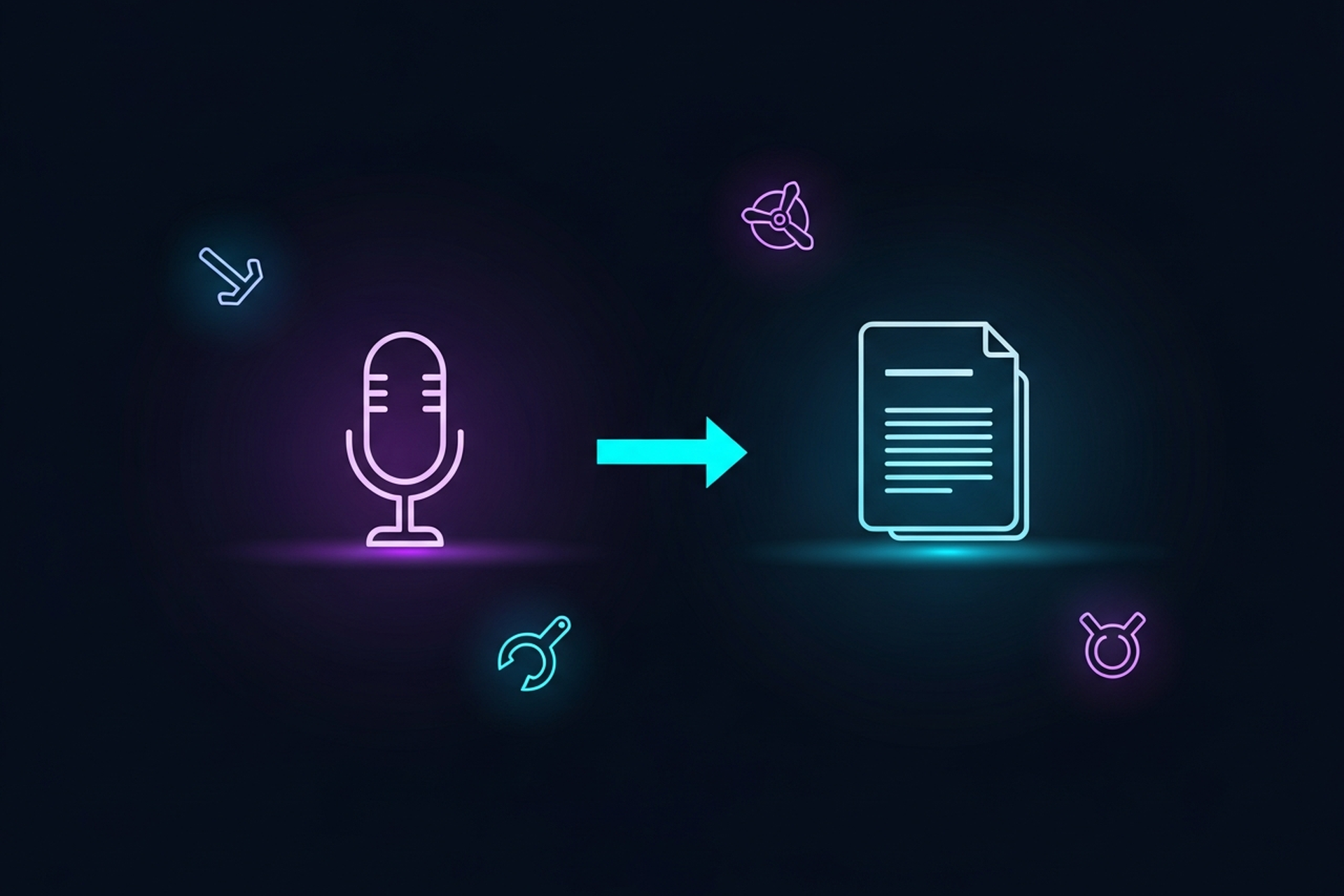
If your team records interviews, you need a way to turn that audio into text fast. Interview transcription software does the heavy lifting so you can focus on content, not manual typing.
But not every tool is built the same. Some are fast but sloppy. Others are accurate but expensive. And a few are genuinely great for B2B podcast teams that need speed, clean output, and integration with their existing workflow.
This guide breaks down what to look for, which tools stand out, and how to pick the right one for your team.

A transcript is not just a backup document. It is one of the highest-value content outputs you can generate from a single recorded interview.
What a transcript unlocks:
If you are running a B2B podcast and not transcribing every episode, you are leaving serious content value on the table. We cover this in depth in our podcast repurposing strategy guide.
The question is not whether to transcribe. It is which tool makes that process the fastest and most accurate for your team.
Before we get into specific tools, here are the key criteria that matter for B2B teams.
Interviews involve at least two people talking, often with industry jargon, company names, and product terminology that generic AI tools get wrong. Look for tools that handle speaker diarization well. That means the software correctly identifies who said what, not just what was said.
If you are publishing on a weekly schedule, you cannot wait 24 hours for a transcript. Most modern AI-powered tools deliver results in minutes. That is the baseline you should expect.
You need to be able to get your transcript out of the tool and into your workflow. Look for exports to: plain text, SRT/VTT for captions, DOCX, and ideally direct integrations with Google Docs or Notion.
Raw transcripts always need cleanup. Whether it is correcting a product name or trimming filler, your tool should make it easy to edit inline and share with teammates.
Some tools charge per minute of audio. Others charge a flat monthly fee. For teams with high volume, flat-rate pricing usually wins. For occasional use, per-minute can be cheaper.
Best for: Teams already in Google Workspace or Zoom
Otter.ai is one of the most widely used audio to text transcription tools in the market. It integrates directly with Zoom, Google Meet, and Microsoft Teams, which makes it easy for teams doing remote interviews.
Strengths:
Weaknesses:
Pricing starts around $10/month per user for the Pro tier.
Best for: Podcast teams that want editing and transcription in one place
Descript is more than a transcription tool. It is a full audio and video editor that lets you edit your recording by editing the transcript text. Delete a word from the transcript and it removes the audio. That is genuinely powerful for podcast production teams.
Strengths:
Weaknesses:
Pricing starts at $12/month for the Hobbyist plan.
For teams doing any kind of audio editing, it is worth checking our best voice editing software guide for more context on how tools like Descript compare.
Best for: Remote interview recording with built-in transcription
Riverside records remote interviews in high-quality local audio from each participant, then transcribes as part of the same workflow. If you are doing video transcription for repurposing as well, Riverside does both in one place.
Strengths:
Weaknesses:
Pricing starts at $15/month.
Best for: Teams that need human-reviewed accuracy
Rev offers both AI transcription and human transcription. The AI tier is fast and affordable. The human tier is slower but significantly more accurate, especially for technical interviews with complex terminology.
Strengths:
Weaknesses:
AI pricing is around $0.25/minute. Human is $1.50/minute.
Best for: Teams using transcription for sales and CRM workflows
Fireflies connects to your calendar and auto-joins meetings to record and transcribe. It is built for sales teams and account management, but podcast teams using interviews for thought leadership will find it useful too.
Strengths:
Weaknesses:
Free tier available. Pro starts at $10/month.
Best for: Technical teams who want free, local, or API-based transcription
OpenAI Whisper is an open-source model you can run locally or access via API. It is one of the most accurate free video transcription and audio transcription engines available, but it requires some technical setup.
Strengths:
Weaknesses:
For B2B teams with a developer on staff, Whisper is worth serious consideration. For everyone else, a SaaS option is the better call.
Here is a simple framework for picking the right interview transcription software for your team.
Speed above all else: Go with Otter.ai or Fireflies.ai. Both deliver transcripts fast and integrate with your existing call stack.
Editing built into transcription: Descript is the clear winner. You edit the words, the audio follows.
Remote video interviews: Riverside gives you the full stack: high-quality recording plus transcription plus clip generation.
Highest possible accuracy: Use Rev's human transcription for your most important content. Use AI for everything else.
Zero ongoing cost with a technical team: Run Whisper locally. It is free and surprisingly accurate.
Transcription is most valuable when it feeds into a broader content system. A transcript should not just sit in a folder somewhere. It should become:
If you are building a B2B podcast that actually drives results, the measurement and analytics side matters just as much as production quality. Transcripts help you track what topics resonate, what guests get the most engagement, and what content is worth repurposing.
The best interview transcription software for your team depends on your volume, your technical setup, and how you plan to use the output. For most B2B podcast teams, Descript or Otter.ai will cover the majority of use cases well.
But here is the thing: the tool is only one piece of the puzzle. If you do not have a system for what happens after the transcript lands, you are still leaving most of the value unrealized.
That is exactly what we help with at Podsicle Media. We handle the full post-production stack: recording, editing, transcription, show notes, and repurposing. So your team can focus on the conversations, not the workflow.
Talk to us about your podcast production needs and we will show you how we turn every interview into a full content engine.