
If your marketing team is evaluating podcast production, you have already cleared the first hurdle: deciding the channel is worth the investment. The harder question is what you are actually buying. Podcast production covers everything from a one-time audio cleanup job to a fully managed content operation, and the gap between those two things is enormous. This guide walks through the full production lifecycle, what each phase involves, realistic cost ranges, and how to evaluate a podcast production company before you sign anything.
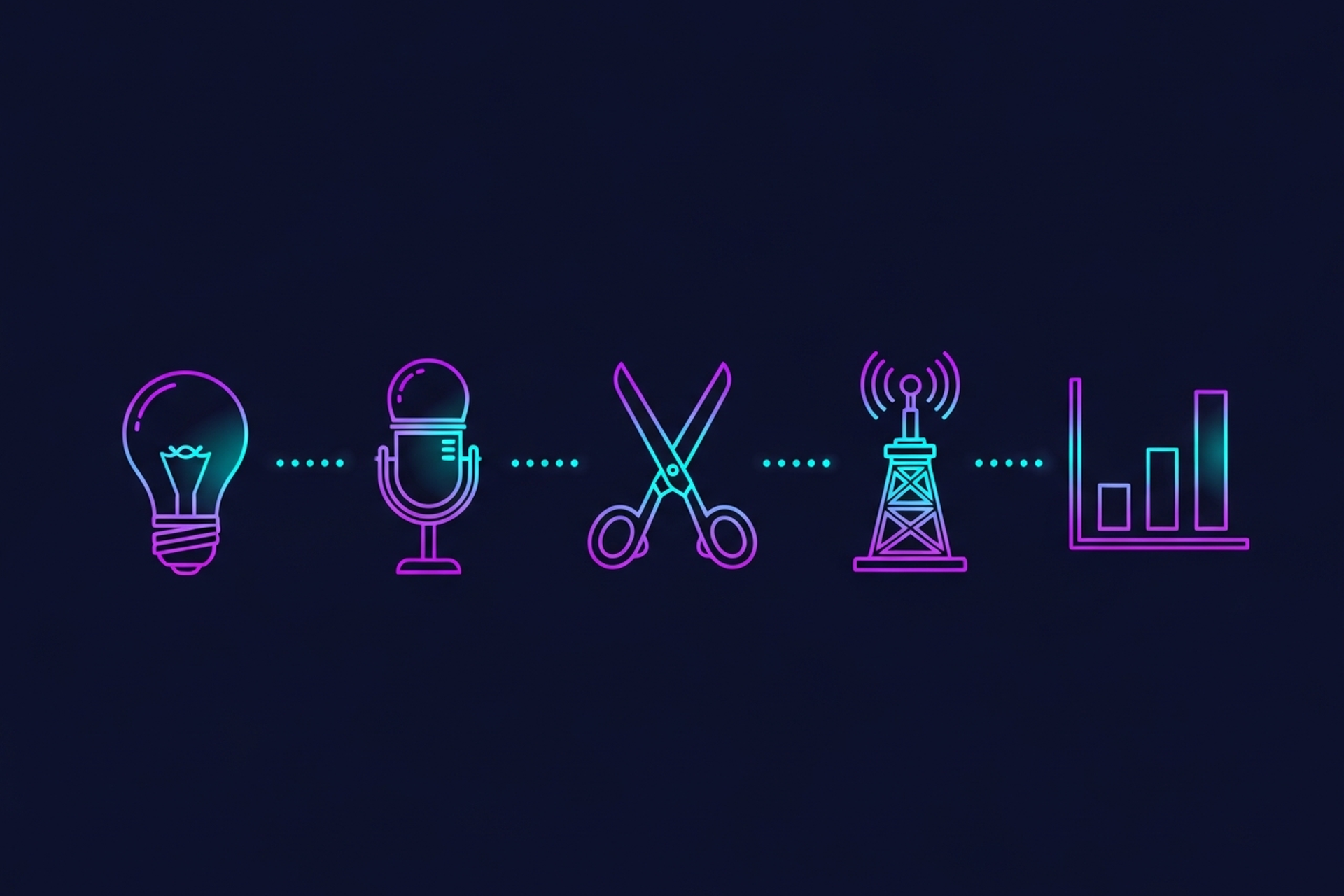
Most buyers come in thinking podcast production means editing. Editing is one piece. A complete production workflow runs through five distinct phases, and buying only one or two of them is how companies end up with great audio that nobody hears.

Pre-production is the strategic layer: show concept, format, episode cadence, target audience definition, guest strategy, and episode briefs. This phase determines whether the show has a reason to exist for your specific buyer.
Recording includes logistics coordination, technical setup guidance, remote recording platform management, and session facilitation. For remote B2B shows, this often means managing Riverside or Squadcast sessions, briefing guests, and handling the technical troubleshooting that kills momentum when left to hosts.
Editing covers audio cleanup, noise removal, level balancing, music integration, and the creation of a final master file. For video podcasts, it also includes cuts for full-length video, short-form clips, and audiogram exports.
Distribution means getting finished episodes onto hosting platforms, optimizing RSS metadata, writing SEO-targeted show notes, creating social content, and pushing clips to the channels where your audience actually spends time.
Analytics closes the loop: tracking downloads, listener demographics, episode performance, and connecting show data to business outcomes like pipeline influenced, leads generated, or accounts engaged.
Most editing-only vendors cover phase three. Most mid-tier production houses cover phases three and four. Full-service podcast production options cover all five.
The DIY vs. professional production question is not really about cost. It is about where your team's time is best spent and whether your internal setup can produce a consistent, quality show over 12 to 24 months.
DIY production makes sense when your team has a dedicated audio engineer or producer, strong editorial processes already in place, and the bandwidth to own scheduling, editing, show notes, distribution, and repurposing each week without it slipping. Companies that run successful DIY shows typically have one full-time person who owns the show completely.
Professional production makes sense when the show is being built to serve a business goal, nobody on your team wants to own the operational load, or you need the show to function as a repeatable content channel rather than a side project. The consistency argument alone is compelling: most branded podcasts that fail do not fail because of bad audio. They fail because production volume drops when internal teams get busy with other priorities.
The middle path is partial outsourcing: you handle strategy and recording, a production partner handles everything downstream. This is a common structure for marketing teams that want control over editorial direction without the production overhead.
Cost ranges in podcast production are wide because scope is wide. Here is how the market actually breaks down.
Editing-only services run $50 to $200 per episode depending on episode length, turnaround time, and whether video is included. This covers audio cleanup and a final master. Nothing else. Useful for shows with an existing internal team that needs to offload the technical work.
Managed production packages run $500 to $2,000 per month for lower-volume shows. These typically include editing, show notes, basic distribution setup, and social clip creation. Strategy is usually light or not included at all.
Full-service production retainers run $2,000 to $10,000 per month and up for high-output or enterprise-level shows. At this tier, you are buying strategic ownership: the production company runs the show as a content channel, not just as a file delivery operation. Guest strategy, SEO-optimized episode metadata, video production, repurposing workflows, and performance reporting are all included.
Podcast production costs scale with three factors: output volume (episodes per month), content deliverables per episode (audio only vs. audio plus video plus clips plus show notes), and the level of strategic involvement the partner provides.
One thing buyers consistently underestimate: the cost of repurposing. A 45-minute B2B episode can generate a blog post, five short-form video clips, a LinkedIn carousel, an email newsletter segment, and a transcript-based SEO article. That content production work is real labor. If your contract does not include it, you are either doing it yourself or leaving value on the table.
Understanding the division of labor before you sign prevents scope disputes and missed expectations.
A professional podcast production company should own: technical setup and platform configuration, audio and video editing, show notes and episode metadata, distribution to major platforms, social clip creation, and performance reporting. At the full-service level, they should also own guest research and outreach, episode briefs, and strategic planning sessions.
You should own: final editorial approval on each episode, access to your audience and guest network, brand voice guidelines, and decisions about how the show connects to broader marketing campaigns. Your production partner should inform those decisions, not make them unilaterally, but the executional work should live on their side of the line.
Professional podcast editing services at the entry level are straightforward: you hand over raw audio, you get back a polished file. As scope expands up toward done-for-you podcast production, the partnership model gets more involved and the collaboration touchpoints increase. Budget time for a weekly or bi-weekly production sync at the full-service tier.
Five things matter most when evaluating a production company as a B2B buyer.
B2B experience is non-negotiable if your show targets a professional or industry-specific audience. Consumer podcast production and B2B podcast production are different disciplines. B2B shows need episode topics tied to buying-stage content, guests who carry professional credibility, and distribution strategies that reach closed LinkedIn or industry media ecosystems. A production company with a portfolio of true-crime shows is not equipped for this, regardless of their audio quality.
Turnaround time affects your content calendar. If your team records on Monday and your show notes are not ready until the following Friday, you are losing a week of distribution momentum. Ask specifically: how many business days from raw file submission to final deliverables, at full capacity, not best-case.
Repurposing services determine whether you get a podcast or a content engine. The companies getting the most B2B value from their shows are not treating each episode as a standalone asset. They are pulling clips, articles, social posts, and email content from every episode. Ask what repurposing is included, what is available as an add-on, and how those deliverables are formatted for your channels.
Strategy involvement separates operators from vendors. Ask how they approach episode planning. Do they help you build a content calendar tied to your buyer journey? Do they advise on guest selection for audience growth? Do they have a view on how your show fits into your broader content strategy? A vendor who answers "we follow your lead on all of that" is an execution shop. That is fine if you have the internal capacity to lead. It is a problem if you do not.
Reporting and accountability tells you whether the partner cares about your results. Ask what metrics they track and how they report them. Vanity metrics (total downloads, episode count) are easy to generate. Outcome-linked metrics (audience growth rate, listener-to-lead attribution, content engagement by episode) require a partner who has thought carefully about what success looks like for a B2B show.
Audio quality is table stakes. A B2B audience will tolerate a guest with a subpar home microphone once in a while. They will not stay subscribed to a show where the audio is consistently difficult to listen to, the episodes run disorganized, or the show notes read like they were written in five minutes.
Beyond audio, production quality in the B2B context means: does the show feel like a professional content channel or a personal project? Are episodes released consistently? Are the topics cohesive and relevant to the intended audience? Is the content accessible in transcript form for buyers who prefer reading?
The production partner you choose sets the ceiling on those outcomes. A company that delivers clean audio files has done their job in a narrow sense. A partner that delivers a reliable, well-positioned, fully repurposed content channel has done something meaningfully different.
B2B buyers are evaluating your brand every time they encounter your content. A podcast that sounds professional, ships consistently, and covers topics they actually care about builds the kind of credibility that shortens sales cycles. A podcast that ships irregularly, lacks editorial direction, and does not connect to distribution channels does the opposite.
Podcast production is not a commodity purchase. The price range is too wide and the scope variation is too significant to shop on price alone. The right question is not "how much does podcast production cost?" The right question is "what does this show need to accomplish for our business, and which production structure gives us the best chance of getting there?"
If your team has strong internal editorial capacity and just needs the operational load lifted, an editing-and-distribution package in the $500 to $1,500 per month range is a sensible starting point. If your goal is to build a show that generates real pipeline, you need a partner with B2B strategic depth, a repurposing workflow, and accountability metrics that go beyond download counts.
Take your time evaluating. Ask for B2B case studies. Talk to their current clients. Confirm turnaround times in writing. The production partner you choose will shape what your show is capable of becoming.
Ready to talk through what your show needs? Contact Podsicle Media to start the conversation.





