
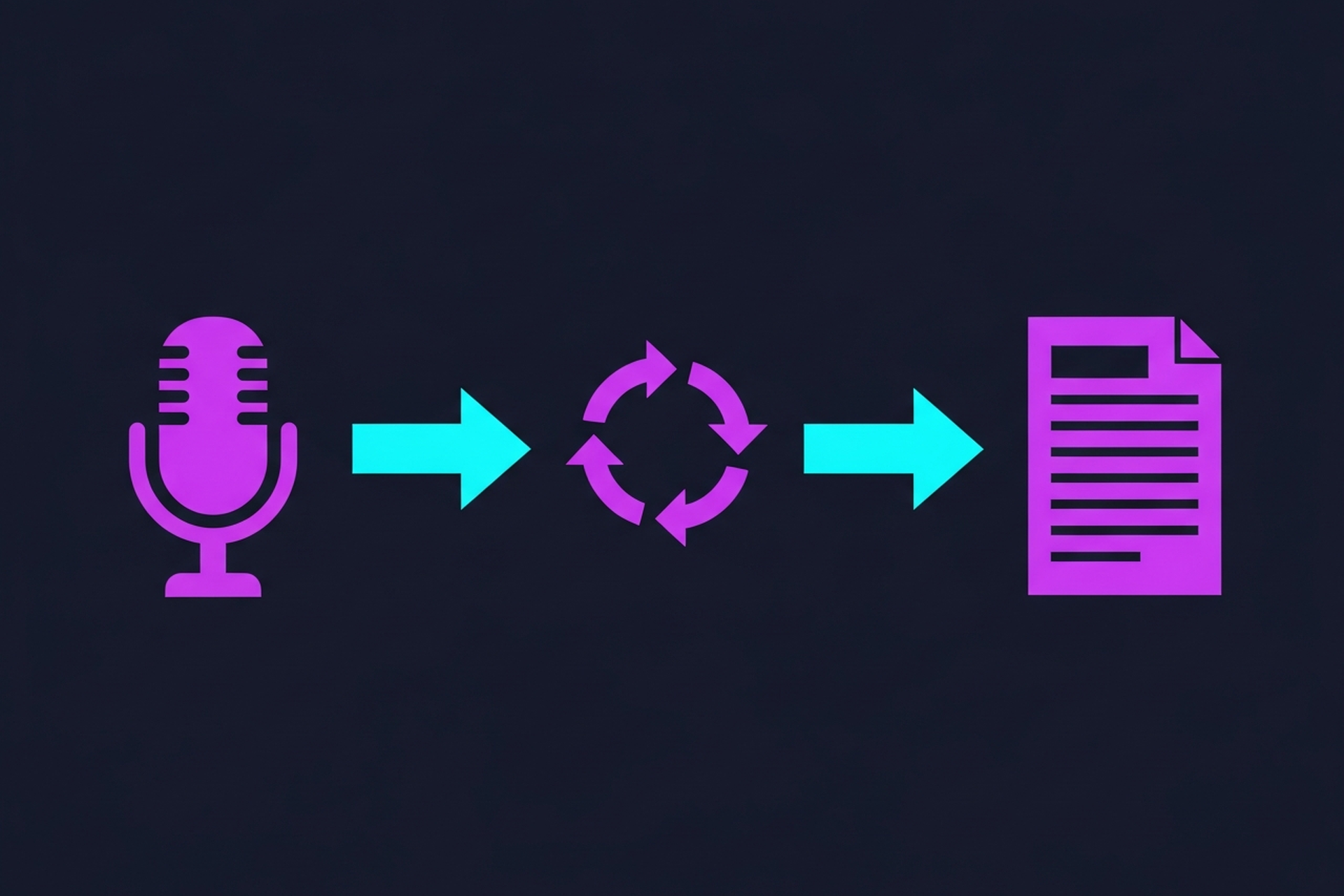

Your podcast is already a content asset. The question is whether you are extracting the full value from it.
Most B2B teams record an episode, post it to their feed, and move on. That approach leaves organic search traffic, lead generation potential, and brand authority sitting unused inside an audio file. Podcast to blog conversion changes that math. When you systematically turn episodes into search-optimized blog posts, you get durable traffic from content you have already paid to produce.
This guide covers the complete conversion workflow: from raw audio to published post, the tools that make it scalable, the SEO rules that make it effective, and the common mistakes that kill the results.
Search engines cannot index audio. Google reads text. Your episode may contain expert insights and detailed frameworks, but if that content only exists as audio, it contributes zero organic search value. Converting to a blog post gives search engines something to crawl, index, and rank.
Blog posts have compound returns. A podcast episode gets most of its listens in the first 30 days. A well-optimized blog post continues generating traffic for years. The same conversation that drove 400 downloads in month one can drive 500 organic visits every month for years after.
B2B buyers research before they buy. They read articles and search for answers to specific problems. When your post answers a question your ideal customer is actively asking, you show up exactly when it matters.
Content budgets are under pressure. Podcast to blog conversion produces high-quality written content at a fraction of the from-scratch cost. The intellectual work has already been done. You are structuring and optimizing ideas that already exist.
Converting a podcast episode to a blog post is not just copy-pasting a transcript. Done correctly, it is an editorial process that produces something better than either the raw audio or a raw transcript would provide on its own.
Everything starts with an accurate transcript. You cannot efficiently build a blog post from audio alone. A clean transcript lets you identify the best insights, structure the narrative, and extract quotable moments without re-listening to the whole episode multiple times.
Use an AI transcription tool like Descript, Otter.ai, or Whisper-based tools for speed. For episodes with multiple speakers, make sure you choose a tool with speaker diarization so you can attribute quotes correctly. For a full comparison of options, see our guide to best transcription software and the tools covered in our AI content repurposing breakdown.
Accuracy matters. Errors in the transcript slow down every subsequent step. If you are using AI transcription, budget 10 to 15 minutes for a human review pass on a 45-minute episode.
A podcast episode and a blog post have different structures. Podcast episodes often meander naturally. Hosts build rapport, go on tangents, revisit points, and circle back. That flow works for audio. It does not work for text.
Before you write a single sentence of the blog post, identify the core argument: what is the single most useful thing a reader will take away from this post? Everything else is support for that central claim.
Read through the transcript and look for:
That is your headline and your thesis. Build from there.
A 45-minute podcast episode has enough content for a 2,000 to 3,000 word post if you let it sprawl. That is usually too much. Target 1,200 to 1,800 words and be ruthless about what makes the cut.
Build a structure before you write:
Pull the best quotes from the transcript and work them in as direct quotations. Attribution adds credibility and differentiates your content from generic AI-generated articles.
Before or during drafting, identify the primary keyword. Check search volume and difficulty using Ahrefs, SEMrush, or Google Keyword Planner. Once you have a keyword, make sure it appears in the title, meta description, first 100 words, at least two subheadings, the URL slug, and the image alt text.
Do not keyword stuff. Write for a human reader first. Search engines in 2026 rank posts that are genuinely useful, not posts stuffed with target phrases.
Pasting a transcript into a CMS and calling it a blog post produces a poor result. Transcript text is conversational, repetitive, and structured for listening. Blog post text needs to be tighter, clearer, and structured for scanning.
Use short paragraphs and lead with the key point of each section. One useful technique: read the transcript to absorb the ideas, then close it and write from memory. This produces cleaner prose and forces you to prioritize what actually matters.
The best podcast-to-blog posts add something the audio did not contain: a supporting data point, an internal link to a deeper resource, a visual diagram, or an expanded tool recommendation. These additions differentiate your post from a transcription and from competitor content. Google rewards genuinely useful content, and bare transcriptions rarely win competitive rankings.
Before you publish, complete the post's metadata:
Not every podcast episode converts equally well to a blog post. Some episodes will drive significant organic traffic. Others will not, no matter how well you write them.
Focus on search demand. Before converting an episode, check whether people are actually searching for the topic. An episode about a highly specific operational decision inside your company may be great audio content but terrible blog material from an SEO perspective. Target topics with search demand of at least a few hundred monthly searches.
One post per core topic. Do not create multiple thin posts from the same episode. If the episode covers three distinct topics, either write one comprehensive post about all three or pick the one with the best search opportunity and go deep on that. Multiple thin posts on related topics compete with each other in search, a problem called keyword cannibalization.
Update older posts. If you have a published post on a topic that a new episode covers in more depth, update the old post with the new insights rather than publishing a competing piece. Refreshed posts often outperform brand-new posts on the same topic.
The manual version of this workflow works but does not scale. If you are converting episodes regularly, you need a stack that handles the repetitive parts automatically.
Transcription: Descript, Otter.ai, Riverside, or a dedicated tool like podcast transcript generators can transcribe a 45-minute episode in under five minutes. Human review of AI output takes another 10 to 15 minutes.
First-draft generation: Tools like Castmagic, Alitu, and Podium can generate a first draft of a blog post directly from a transcript. Treat this as a starting point, not a finished product. The editorial step described above still applies.
Content repurposing platforms: Platforms that handle the full repurposing stack, from transcription through social clips and email summaries, let you convert an episode into multiple assets from a single workflow. See our complete breakdown in the podcast content repurposing tools guide.
CMS integration: Some tools integrate directly with your CMS to push drafted posts for review. This removes the copy-paste step and reduces errors.
Publishing raw transcripts. A transcript is not a blog post. Search engines know the difference and so do readers. Transcripts have high bounce rates, low time-on-page, and minimal organic ranking potential.
Skipping keyword research. Writing a great post on a topic no one searches for produces zero traffic. Keyword research is not optional for conversion to produce ROI.
No internal links. Every blog post you publish should link to at least two other posts on your site. Internal links distribute ranking authority and help search engines understand your site's topical structure. Most podcast-to-blog conversion workflows skip this step entirely.
Ignoring the conversion funnel. Blog posts should do something. Define whether the post's goal is to drive newsletter signups, demo requests, or deeper content engagement, and include a clear CTA that moves the reader toward that goal. A post without a CTA is a missed opportunity.
Converting every episode equally. Not every episode deserves a full conversion effort. Prioritize episodes on topics with real search demand and skip the ones on internal company topics that no one outside your organization would search for.
The teams that get the most from podcast to blog conversion turn it into a system rather than a one-off effort. Define roles: who handles transcription review, who writes, who does keyword research, who publishes. Set a target turnaround time of 5 to 7 business days post-release. Build a content calendar that maps upcoming episodes to high-value search topics so keyword research is done before recording, not after.
Track results in Google Search Console. Monitor impressions, clicks, and average position for converted posts. This data tells you which topics and formats are resonating and where to focus next.
If you are running a B2B podcast and not converting episodes to blog posts, you are leaving organic traffic on the table every week. The workflow is not complicated. The tools exist. The ROI is real.
Ready to turn your podcast into a content engine that drives measurable results? Talk to Podsicle Media about our done-for-you production and repurposing service.





