Most B2B podcasters treat transcription as a compliance step. Turn in the transcript, check the box, move on. That mindset is costing them serious organic traffic and content leverage they've already paid to produce.
Podcast transcription services aren't just an accessibility feature. For B2B teams that get it right, a transcript is a content multiplication engine and an SEO compounding machine rolled into one. This guide covers how to choose the right service tier, what accuracy levels you actually need, and how to build the workflow that turns every episode into a full content system.
Search engines can't listen to audio. They index text. That means every minute of untranscribed podcast content is invisible to Google, regardless of how good the episode is.
When you add dedicated episode pages with full transcripts, Google treats each one as a standalone piece of content. That's episode-level indexing: every guest name, every topic covered, every insight shared becomes searchable. Podcasts that publish consistent transcripts see 30 to 40 percent more organic visibility through this mechanism alone.
The compounding effect matters here. One episode's transcript might drive modest traffic on its own. But 20, 40, or 100 episodes of indexed content creates a topical authority signal that pushes your entire site up the rankings. Most teams see initial improvements within 30 to 60 days of consistent publication, with significant organic traffic growth landing around the three to four month mark.
This is one of the most underused advantages in b2b podcast marketing and promotion. Your competitors are probably leaving it on the table.
The market has shifted fast. AI transcription accuracy is now near-parity with human transcription for most standard audio, and research on AI transcription benchmarks shows leading platforms consistently hitting 95 to 99 percent accuracy rates.
Here's what the current pricing landscape actually looks like across service tiers:
AI vs. Human Transcription
Accuracy, cost, and speed by service tier

The gap between budget AI and premium AI matters for B2B content. At 85 percent accuracy, you're looking at meaningful editing time on every transcript, which erodes the cost advantage quickly. Premium AI at 95 to 99 percent accuracy hits a sweet spot where light review is enough and the per-minute cost is still 5 to 10 times cheaper than human transcription.
About 70 percent of podcasters have already switched to AI transcription for exactly this reason. Human review still makes sense for highly technical content, sensitive topics, or episodes where accuracy directly affects legal or compliance risk.
Not all platforms are created equal. Here's what to know about the main options.
Sonix is a strong choice for teams that want speed and integrations. It connects directly to most podcast hosting platforms and exports to multiple formats. At $10 per hour for automated transcription, it's mid-range on price with above-average accuracy. The editor interface makes review fast, which matters when you're processing multiple episodes per week.
Rev offers the widest range of options: AI at $0.25/min, guaranteed 99% AI accuracy at $1.50/min, human transcription at around $1.50 to $2/min standard, and $2.75/min for rush delivery. Research comparing transcription accuracy across platforms consistently places Rev near the top for AI accuracy on mixed audio conditions.
Descript is built for teams that want transcription baked into the editing workflow. You transcribe the audio, then edit the transcript to edit the audio. For B2B teams producing polished episodes, it eliminates a step in the production pipeline. The tradeoff is cost: Descript is priced as a production tool, not a transcription-only service.
Podsqueeze is worth looking at for teams that want automated podcast repurposing tools alongside transcription. It generates show notes, social posts, and email content from the transcript automatically, which accelerates the content multiplication workflow covered in the next section.
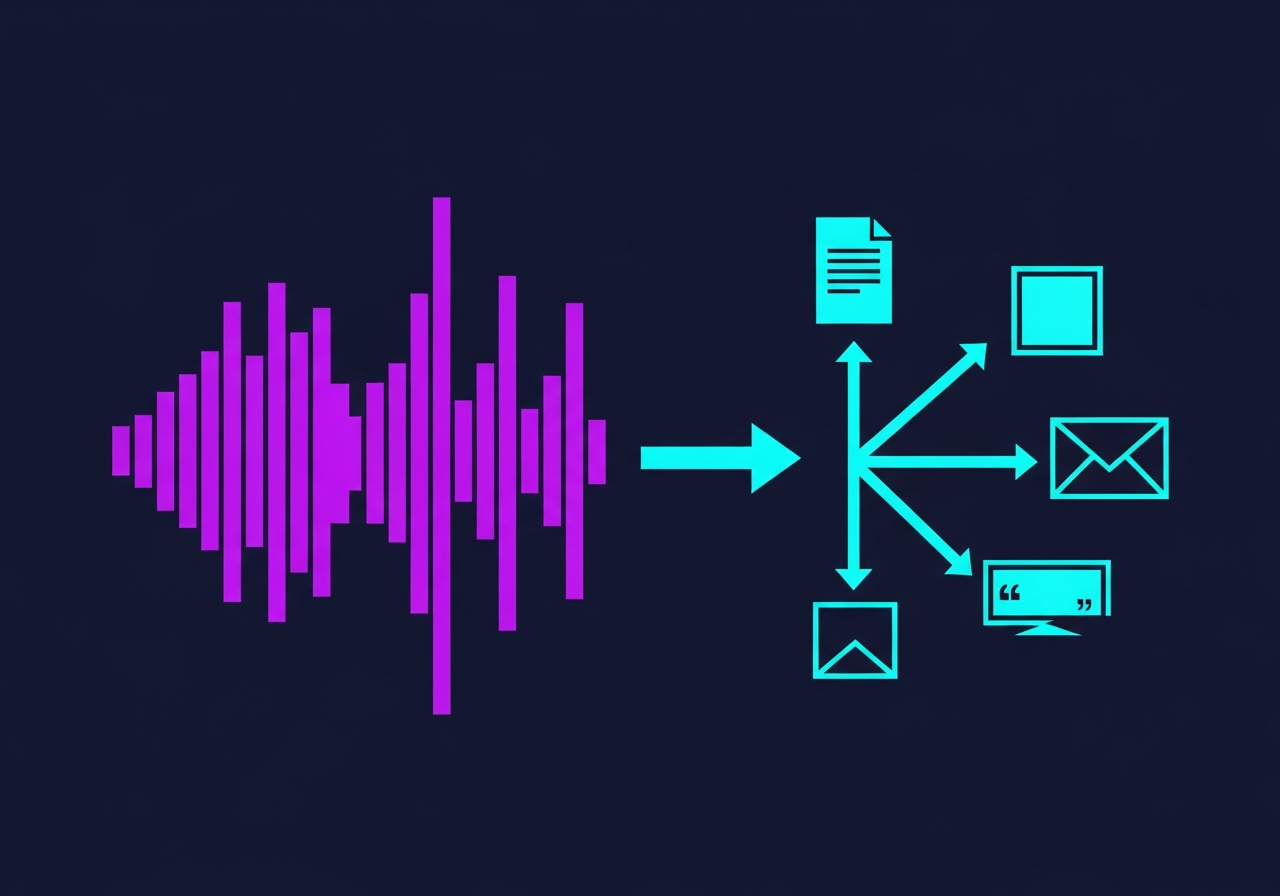
Here's the actual leverage play. A transcript isn't just a text file. It's raw material for your entire content operation.
A single 30 to 45-minute episode transcript can generate: a long-form blog post built around the episode's core argument, three to five LinkedIn or X posts pulling specific insights or stats, show notes for the episode page, an email newsletter summarizing the key takeaways, pull-quote graphics for social, and AI-assisted sales follow-up sequences built around topics your buyers care about.
That's what b2b podcast content strategy looks like when it's actually working. You record once, and the content engine runs for weeks.
The workflow for most B2B teams looks like this: transcribe immediately after publishing, run a quick accuracy review, then use the transcript as the input for every downstream content asset. AI tools can handle much of the transformation work once the transcript is clean.
According to research on podcast content distribution workflows, teams using systematic content multiplication report significantly higher ROI from their podcast investment, not because they're producing more raw episodes but because they're extracting more value from every episode they already produce.
This connects directly to how podcast clip repurposing works at the asset level. The transcript is the foundation everything else is built on.
Choosing a transcription service is step one. Building a repeatable workflow is what actually compounds over time.
For most B2B teams running one to two episodes per week, the practical setup is: premium AI transcription for speed and accuracy, a 20 to 30 minute human review pass to catch errors and format speaker labels, and a standard template for converting the transcript into downstream assets. The whole process should take under two hours per episode once the workflow is established.
If you're producing technical content, where industry jargon, product names, and specific terminology are frequent, run a test batch through two or three platforms before committing. Accuracy varies more on specialized vocabulary than on general conversational speech, and a platform that claims 99 percent accuracy on general audio might score significantly lower on your specific content.
One more thing to get right: where the transcript lives. A PDF attached to your episode page does nothing for SEO. A full indexed text page, either the episode description itself or a dedicated show notes page with the transcript embedded, is what gets you the organic visibility gains. This is the single most common mistake B2B podcasters make with transcription, and it's an easy fix.
The right service depends on three factors: volume, accuracy requirements, and workflow integration.
High-volume teams producing three or more episodes per week should prioritize API access and batch processing. Sonix and Rev both offer API options that can automate the transcript delivery step entirely, removing it from your manual production queue.
Teams with technical or sensitive content should budget for human review, at minimum as a spot-check layer on top of AI transcription. The cost difference between AI-only and AI plus human review is small compared to the risk of publishing inaccurate content in regulated industries.
Teams focused on content multiplication should weight platform selection toward tools with built-in export options and integrations. Getting the transcript into your content workflow quickly matters more than marginal accuracy improvements at the top end.
The podcast transcription market is growing fast: it was valued at $10 billion in 2023 and is projected to reach $30 billion by 2031. That growth reflects what more teams are figuring out: transcription is infrastructure for the content operation, not an optional add-on.
If you're not transcribing every episode, start now. Pick a premium AI platform, run your last five episodes through it, and build the downstream content from those transcripts. That's enough to prove the system works before you optimize the workflow.
If you're already transcribing but not publishing full indexed episode pages, fix that first. It's the highest-leverage SEO change you can make on an existing podcast without producing a single new episode.
Transcription isn't the end of the workflow. It's the beginning. And for branded company podcasts trying to build real organic reach and content ROI, it's the foundation everything else runs on.