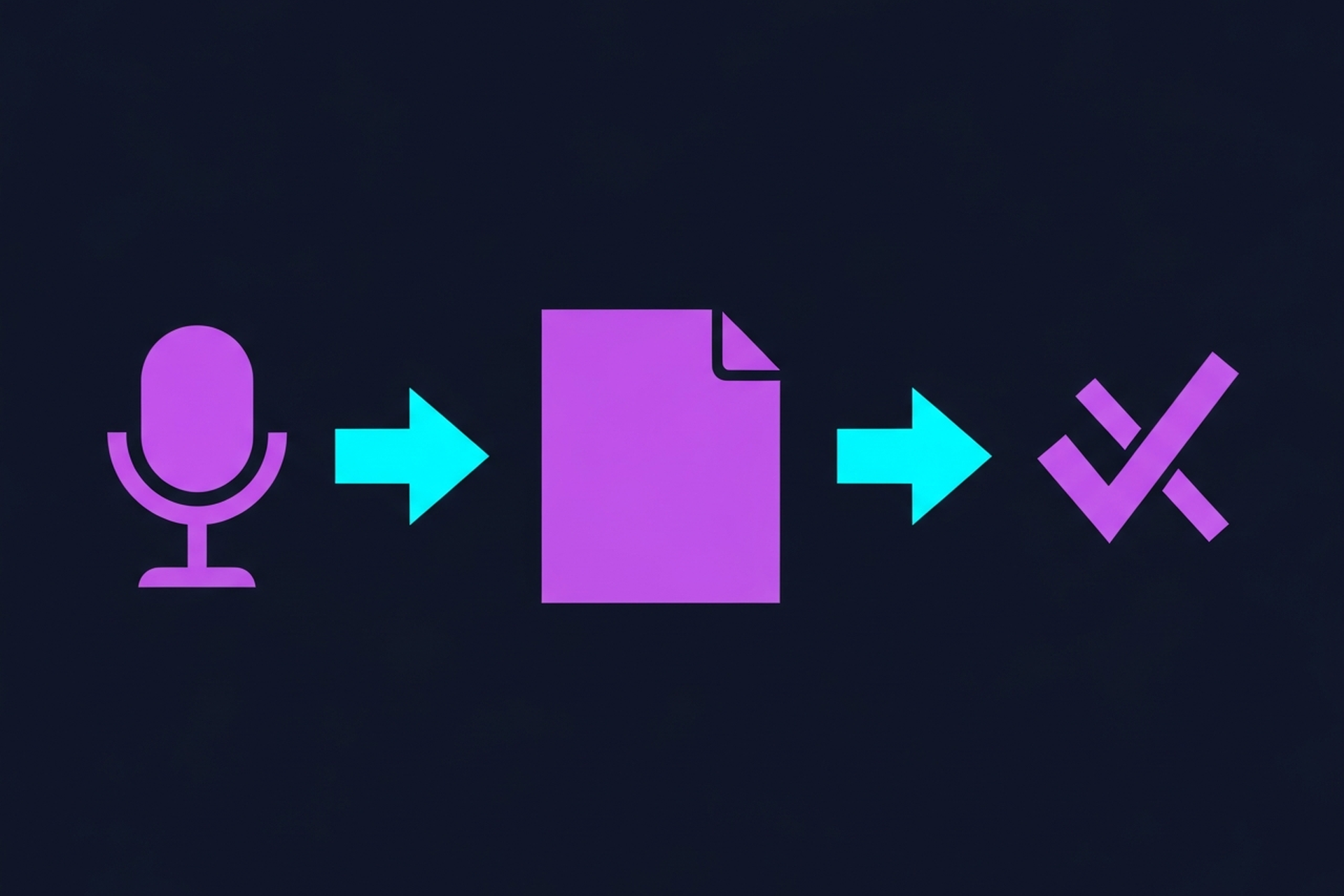

Every podcast episode your company produces contains hours of expertise in audio format. Most of that content never gets found, quoted, referenced, or repurposed, because audio is not indexed by search engines, not skimmable, and not easy to extract insights from at scale. Transcription solves all three problems.
When you transcribe audio to text, you unlock the underlying content in a form that can become blog posts, show notes, social clips, email content, internal knowledge bases, and more. For B2B brands running podcast programs, transcription is the connective tissue between your audio content and everything else.
This guide covers how transcription works, the tools available, what to look for in accuracy and workflow integration, and how transcription fits a broader content repurposing strategy.
B2B podcast audiences are smaller and more targeted than consumer podcast audiences. A show reaching 2,000 listeners per episode in a defined industry vertical can deliver far more pipeline value than a general-audience show with 50,000 downloads. But smaller audiences mean fewer organic discovery pathways. Transcription addresses this directly.
A transcribed episode becomes a searchable document. When that transcript is edited into a blog post or show notes page with proper headers and structure, it can rank in search for the exact terms your buyers are using. The conversation your CEO had with a guest about enterprise procurement challenges is the same content that could rank for "enterprise procurement best practices" or "procurement technology evaluation" depending on how it is structured.
Beyond SEO, transcription enables:
Accessibility. Deaf and hard-of-hearing listeners and those who prefer reading to listening can consume your content. This is a legal and ethical consideration for any media company.
Quote extraction. Finding exact timestamps for social media quotes is slow without a transcript. With a transcript, you can search for the best lines in seconds and generate social content at scale.
Internal knowledge management. For companies using podcasts to document institutional knowledge, industry conversations, or customer interviews, transcripts create a searchable archive of everything ever discussed.
Sales enablement. Prospects can scan a transcript to find the section most relevant to their evaluation criteria before listening to the full episode.
All modern automated transcription tools use speech recognition models trained on large audio datasets. The quality of a transcript depends on three variables: audio clarity, speaker accents, and technical vocabulary.
Audio quality is the most controllable factor. A clean recording with minimal background noise, captured on a decent microphone, will transcribe with significantly higher accuracy than a phone recording or a recording with heavy reverb. This is another reason audio cleanup is not optional for production teams that plan to repurpose content.
Speaker accents affect accuracy on all current models to varying degrees. Most major tools perform well on standard North American and British English. Accuracy varies more on regional accents, non-native English speakers, and other languages. If your show regularly features guests from diverse linguistic backgrounds, test your transcription tool of choice against a representative sample.
Technical vocabulary is the variable teams most often underestimate. AI models trained on general speech handle everyday language well. A cybersecurity podcast, a pharma industry show, or a manufacturing operations program will include jargon that general models may mishear or mangle. Custom vocabulary training, human review, or subject-matter-specific models address this.
The transcription tool market has consolidated around a handful of strong options. Here are the ones most relevant to B2B podcast teams:
Otter.ai is widely used for its real-time transcription and meeting integration. For podcast use specifically, accuracy on pre-recorded audio is solid for clear recordings. Speaker identification works reasonably well with two or three speakers. The free tier limits monthly usage; paid plans start at around $16/month.
Descript is the most podcast-native option in this category. It transcribes automatically on upload and layers transcription directly into the editing interface. You can edit the audio by editing the text, which changes the production workflow entirely. For teams doing both editing and repurposing, Descript's integrated approach eliminates a significant amount of toolchain complexity.
Whisper (OpenAI) is an open-source model available for free. Accuracy is competitive with commercial tools. It requires technical setup to run locally or API integration to use via other platforms. For teams with engineering resources, Whisper is the highest-value option at near-zero ongoing cost.
AssemblyAI and Deepgram are developer-facing APIs used to build custom transcription workflows. Both support speaker diarization (labeling who said what), sentiment analysis, and content safety detection. For production companies managing high-volume transcription, API-based tools with programmatic access make more sense than subscription tools designed for individual users.
Rev operates a hybrid model: AI transcription with optional human review. For verbatim accuracy, especially in highly technical content, human transcription remains more reliable than AI. Rev's human turnaround is slower (typically 12-24 hours) and costs roughly $1.50-$2.00 per minute.
Industry benchmarks put top AI transcription tools at 85-95% word accuracy on clean audio. That sounds high until you consider what 5-10% error means in practice: in a 45-minute episode at roughly 130 words per minute, that is 350-700 incorrect or missing words. The actual experience depends heavily on where the errors concentrate. Errors on filler words and minor connectives matter less than errors on product names, client names, or technical terms.
For most B2B podcast use cases, AI transcription is accurate enough for a workflow where a human editor reviews and corrects the output before publication. The goal is not a verbatim legal transcript. It is an accurate enough working document that a content editor can turn into a blog post or show notes without spending significant time deciphering what was actually said.
Build your accuracy expectations around this workflow reality: AI transcription gets you 90% of the way there in minutes; a 15-30 minute human review pass gets you to publication-ready.
Transcription is most valuable when it is the first step of a structured repurposing workflow, not an isolated action. The workflow that works for most B2B podcast teams looks like this:
Step 7 deserves emphasis. Transcripts are source material. A blog post is not a transcript reformatted with paragraph breaks. It requires a different structure, narrative flow, and editorial judgment about what to include, cut, and reframe for readers versus listeners. The transcript provides the raw material; a human editor (or a well-prompted AI) shapes it into a reading experience.
For a full walkthrough of how this workflow connects to your broader content calendar, see how B2B podcast content strategy treats transcription as part of the multi-channel output plan.
If you want to evaluate transcription without committing to a paid tool, several free options work well for testing:
OpenAI Whisper via Hugging Face Spaces or community-built interfaces lets you transcribe short files at no cost.
Otter.ai free tier includes 300 minutes per month, which covers six to eight average-length podcast episodes.
Adobe Podcast includes transcription as part of its free audio enhancement tool.
YouTube automatically transcribes uploaded videos. If you are publishing video podcast episodes to YouTube, the auto-captions are an imperfect but usable transcript that can be downloaded and cleaned up.
For a team publishing one to two episodes per week, starting with free tools and upgrading to a paid tier once the workflow is established is a reasonable approach. The goal in the early stages is proving out the repurposing workflow, not optimizing every tool choice.
If transcription is handled by your podcast production partner rather than internally, evaluate it on these criteria:
Is transcription included in the production fee or billed separately? Bundled transcription is generally better value and eliminates a coordination step.
Who reviews the transcript? Fully automated transcription with no human review is faster but less reliable for technical content. Ask whether a human editor corrects the output before delivering it to your team.
In what format is the transcript delivered? A clean, formatted document is more useful than a raw text dump. Speaker labels, timestamps at regular intervals, and paragraph breaks all reduce the editorial work your team needs to do.
Does the partner handle repurposing, or just transcription? If your goal is turning episodes into blog posts and social content, a production partner who handles the full repurposing workflow delivers significantly more value than one that stops at transcription delivery.
Podsicle Media includes transcription and show notes as part of every episode production, with human review built in. If you want to understand what the full workflow looks like for your show, schedule a call and we can walk through the specifics.
The SEO case for podcast transcription is straightforward: search engines index text, not audio. An episode that exists only as an audio file generates zero organic search traffic. The same content turned into a structured page with a transcript, show notes, and an edited blog post can rank for multiple search terms your buyers are actively using.
The compounding effect is meaningful for B2B brands with consistent publishing schedules. A show publishing 40 episodes per year generates 40 new pieces of indexable content, plus the blog posts and articles derived from them. The authority and backlink profile of your podcast content page grows with each episode you publish and transcribe.
For teams thinking about how transcription connects to the full content output from a podcast program, the podcast transcription services guide covers the service options in detail.
The short version: transcription is not a nice-to-have in a modern B2B podcast operation. It is the mechanism that connects your audio content to everything else you are trying to accomplish with it.